The e-bike battery passport deadline is February 2027. Get ready before it becomes urgent.
A digital passport and QR code for every LMT battery placed on the EU market, ready for your production line.
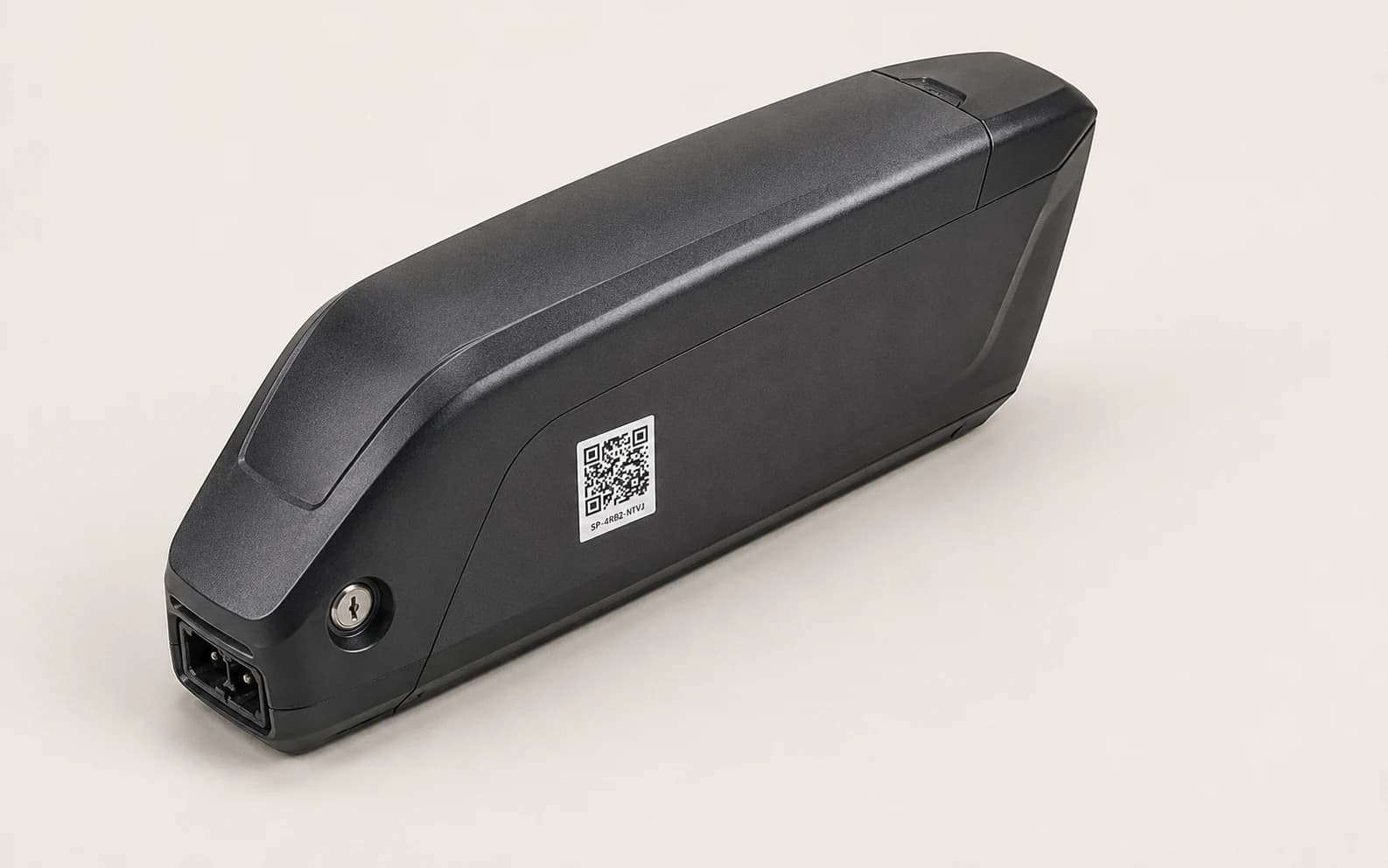
Regulatory details and applicable articles
From 18 February 2027, every light means of transport battery — e-bike, e-scooter, e-moped, at any capacity — placed on the EU market needs a digital battery passport and a QR code on the pack. Article 77(1) and Article 13(6) are the only two deadlines in Regulation (EU) 2023/1542 with no conditional clause attached.
Three batteries, three verdicts. Scan all three.
Each label resolves to this system, with the same server-side filter a customer gets: one verifies, one flags an opened tamper loop, one says authenticity cannot be verified. If you would rather read one with the parts explained, see a battery passport example, annotated field by field.
Three numbers decide your estimate
The full list is published. The simulator returns your figure in a minute, and on Startup you order online and pay by card.
These are our numbers. For the whole market’s, how much a battery passport costs, line by line.
What happens between the estimate and the first paired label
Four steps, and no demo call among them. The two that are yours take minutes, and nothing is quoted by email.
- 01
Estimate online, two minutes against the published list.
you - 02
Order. Startup pays by card, Standard by invoice.
you - 03
Serials minted, carriers printed and shipped, or print files sent.
us - 04
Labels paired on the line, and the first event lands on the record.
you
Link every physical battery to its digital passport
During production, use the Stele Android app to scan the battery serial number and the passport QR code. The association is recorded automatically.
A battery nobody can identify is a battery nobody can recall
The passport is the first thing that puts a unique identifier on the individual pack. That is what separates a recall you can aim from a notice asking a whole market to go and look at its bikes.
Explore the evidence, recall path and verification limits
When a pack turns out to be dangerous, Article 79(3) requires the corrective action to cover every non-compliant battery the operator has made available throughout the Union, and the notice to authorities must carry the data necessary for the identification of the non-compliant battery. Under the General Product Safety Regulation a recall has to reach all affected consumers that can be identified. Statutory traceability, though, runs only one step up and one step down the chain, kept for ten years: Article 46(2). It identifies companies, not units.
The fires on record come overwhelmingly from packs outside the manufacturer’s chain, which are exactly the packs that will carry no passport at all. Of the e-bike fires notified to the UK product-safety regulator for 2024, 45% of 170 were confirmed post-market conversions; government-commissioned analysis of London Fire Brigade incidents from 2017 to 2023 found that, of the 56% where the build could be ascertained, over three quarters were conversion kits.
What a label proves is narrow, and worth saying plainly. A printed QR code can be photographed and reprinted onto a counterfeit pack; a keyed chip cannot. A tap tells you a genuine chip answered and whether the seal has been broken since it was applied. It does not tell you the cells are sound: an authentic pack can still catch fire. None of this is a fire-safety promise. It is what makes a recall land on the right batteries instead of all of them.
Counterfeit batteries, conversions and what a passport can prove, with every figure and its exact scope.
- Printed QR
- Identifies the battery. Cannot prove this physical pack is the one registered: a printed code can be copied.
- Keyed NFC tag
- A genuine, individually keyed chip answered this tap. It cannot be photographed and reprinted.
- Tamper loop
- The seal was intact, or it was not, since the label was applied.
- Neither proves
- That the cells inside are safe. That is what testing and conformity are for.
February 2027 is a purchase-order question, not a February question
A worked example with typical lead times for packs built in Asia, counted back from the date itself. Substitute your own: the deadline does not move, so the order date is what moves.
- by Oct 22, 2026
Purchase order placed, serials minted first
your window - 8 weeks
Pack production, passports paired on the line
- 6 weeks
Sea freight to an EU port
- 3 weeks
Customs and inbound handling
- Feb 18, 2027
Placed on the EU market: passport live, QR on the pack
fixed
The last stop is written in Brussels. The other four are written by your supply chain. Why the last stop cannot move
The obligation lands on whoever places the battery on the market
Not the cell maker in Asia, not the shop that sells the bike: the operator whose name is on the pack when it enters the Union, which for most of our customers means the brand on the frame.
- cell manufacturernot obliged
- pack assemblernot obliged
- brand placing it on the EU marketobliged
- dealernot obliged
- ridernot obliged
The questions every first order starts with
Short answers, each with the article it rests on. The full chain, including the 2031 dates that are not the passport, is on the deadline page.
Does an e-bike battery need a battery passport?
Yes. From 18 February 2027 every LMT battery, which includes e-bike, e-scooter and e-moped batteries, placed on the EU market or put into service needs a digital battery passport, with no capacity threshold: Article 77(1) of Regulation (EU) 2023/1542.
Who is responsible for the battery passport?
The economic operator that places the battery on the EU market: the brand selling packs under its own name, or the importer bringing them in from a third country. Not the cell maker abroad, not the dealer, not the rider. An assembler mounting packs a supplier already placed on the EU market is a distributor: there the passport is the supplier's duty.
Can the 18 February 2027 deadline slip?
The date is written directly in Article 77(1), is not conditional on any delegated or implementing act, and has never been amended since 2023. The one postponement in the regulation so far moved supply-chain due diligence, Article 48, to August 2027, and touched nothing else.
Are batteries already on the market before the deadline affected?
No. The obligation is not retroactive: a battery first made available in the EU before 18 February 2027 never needs a passport, even if the vehicle carrying it sells later. What you do need is proof of that first-placement date, batch by batch, for market surveillance.
What has to be on the battery itself?
From the same date all batteries must be marked with a QR code, and for an LMT battery the code must give access to its passport: Article 13(6)(a) and Annex VI Part C. It is a printed label on the pack, not just a link on a website.
What information does a battery passport have to contain?
Annex XIII sets out the list, which the European Commission has numbered as 71 data points across four levels of access. For a light means of transport battery, 59 of them apply from 18 February 2027, and 49 of those are mandatory while the other 10 apply only if the case arises. The remaining 12 are repetitions, electric-vehicle items, or wait on a further act.
The full list, with the access level on each lineThe same fields, annotated on an example passport
The date will not move. Your order can.
Estimate on your own volumes, order online, and the file is open. Startup carries no setup fee and pays by card, and up to 5,000 passports it costs the same as Standard to the cent, because €1.00 times 5,000 is the first setup step.